
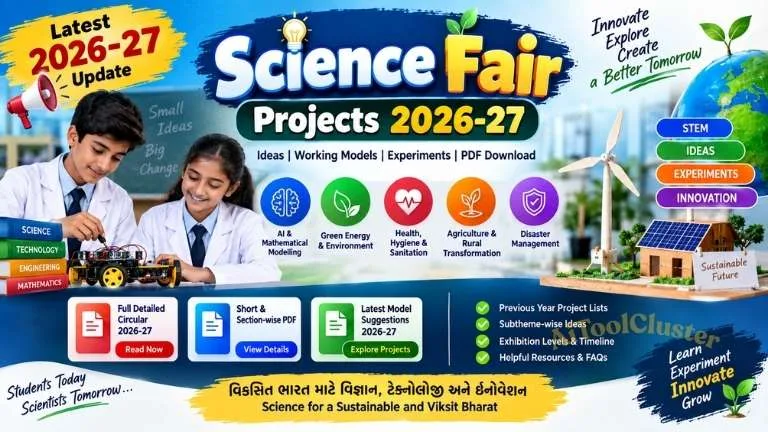
Science Fair Projects 2026-27: STEM Kits, Working Models & PDFs
Find Gujarat science exhibition circulars, project collections and practical working model ideas for students and teachers. Start with the circulars below, then use the experiment guides to choose materials, plan a fair test and prepare your project report.
Explore water conservation, renewable energy, agriculture and mathematical modelling. Choose a project that students can build, measure and explain themselves.
Latest Science Fair 2026-27 Important Downloads
| Document | Details | Open |
|---|---|---|
| Science Fair 2026-27 Full Detailed Circular | Detailed guidelines, themes and planning information | Open Science Fair 2026-27 Full Detailed Circular |
| Science Fair 2026-27 Short & Section-wise PDF | Quick reference for the latest sections and themes | Open Science Fair 2026-27 Short & Section-wise PDF |
| Science Working Model Suggestions 2026-27 | Latest project and working model suggestions for students | Open Science Working Model Suggestions 2026-27 |
મહત્વપૂર્ણ સૂચના – બાળ વૈજ્ઞાનિક પ્રદર્શન 2026-27
શિક્ષકો અને બાળ વૈજ્ઞાનિકો ખાસ ધ્યાન આપે.
નીચે આપેલો વિષય અને વિભાગોનો સારાંશ સંદર્ભ માટે છે. ભાગ લેતાં પહેલાં જોડાયેલ પરિપત્રમાં વર્ષ, વિષય અને નિયમો ચકાસો. તેથી જૂના વર્ષના વિભાગને આધારે મોડેલ તૈયાર કરતાં પહેલાં વર્ષ 2026-27નો નવો પરિપત્ર અવશ્ય વાંચવો.
મુખ્ય વિષય:
ટકાઉ અને વિકસિત ભારત માટે વિજ્ઞાન, ટેક્નોલોજી અને ઈનોવેશન
- બહેતર જીવન માટે Artificial Intelligence (AI) અથવા Mathematical Modelling and Computational Thinking
- હરિત ઊર્જા અને પર્યાવરણ સંરક્ષણ
- આરોગ્ય, સ્વચ્છતા અને સેનિટેશન
- સ્વદેશી કૃષિ પદ્ધતિઓ અથવા ગ્રામિણ રૂપાંતરણ માટે વિજ્ઞાન
- આપત્તિ વ્યવસ્થાપન
ખાસ સલાહ: Science Fair માટે મોડેલ પસંદ કરતાં પહેલાં નીચે આપેલ Full Detailed Circular અને Short Section-wise PDF વાંચો.
Science Fair Theme: Circular Summary
Main Theme: Science, Technology, and Innovation for a Sustainable and Viksit Bharat
The Science Fair 2026-27 encourages students to connect science, technology and innovation with practical problems faced by people, communities and the environment.
A useful science project should identify a real problem, explain the scientific principle behind it, demonstrate a possible solution and clearly show how the idea can be useful in real life.
Science Project Ideas to Match with Your Circular
How to Select a Strong Science Fair Project
A successful Science Fair model is not only about decoration. Start by identifying a real-world problem around your school, home, village, agriculture, environment or community.
Study the scientific reason behind the problem. Then design an experiment, working model or innovative solution. Record observations, compare results and explain what makes your idea useful.
Modern school projects can combine STEM education, engineering design, environmental science, laboratory experiments, sensors, electronics, mathematical analysis and innovative problem-solving.
Choose a Project by Materials and What You Can Measure
A useful school project answers a small question with evidence. The following are suggested classroom investigations, not official competition categories or tested performance claims.
| Project | Materials | Measure and compare |
|---|---|---|
| School water-use study | Measuring jug, timer, notebook | Tap flow in litres per minute; estimated use at different running times |
| Soil moisture conservation | Matching pots, equal soil, dry-leaf mulch, measuring cup | Mass change in covered and uncovered pots under the same conditions |
| Solar panel angle | Small educational solar panel, multimeter, angle guide, fixed load | Voltage across the same load at different angles, measured close together in time |
| Paper bridge design | Equal paper sheets, supports, identical small weights | Load supported by flat, folded and rolled structures with the same span |
| Rainwater collection model | Cardboard roof, tray, tube, measuring jug | Volume collected from an equal amount of poured water; compare leakage |
Project 1: Measure Water Use at a School Tap
Question: How much water flows while a tap remains open?
- With a teacher supervising, collect water for 10 seconds in a measuring container. Keep the tap at the same opening.
- Repeat three times and calculate the average volume. Reuse collected water appropriately.
- Calculate flow: litres per minute = collected litres × 60 ÷ collection seconds.
- Use the measured flow to estimate water use for different tap-running times. Label estimates separately from direct measurements.
Illustrative calculation: 0.5 litres in 10 seconds equals 3 litres per minute. At that flow, reducing running time by 20 seconds saves an estimated 1 litre per use. These are example numbers, not results from your school.
Display: Show the problem, three readings, average flow and a practical suggestion such as closing the tap while soaping hands. Discuss how changing water pressure affects the estimate.
Project 2: Does Mulch Reduce Soil Water Loss?
Question: Does covering soil with dry leaves reduce water loss compared with uncovered soil?
- Prepare two matching containers with the same dry soil mass and the same measured water quantity. Use no plants for this comparison.
- Add a measured layer of dry leaves to one container. Leave the other uncovered.
- Weigh each prepared container at the start, then at the same time daily. Compare each container’s change from its own starting mass.
- Keep location, container size and other conditions alike. Avoid drainage differences and repeat the experiment before drawing conclusions.
Record: Date, starting mass, current mass, mass lost and weather conditions. A lower mass loss is consistent with reduced water loss under the test conditions; do not claim a fixed saving for all farms.
Buying a STEM Kit: What Is Actually Needed?
Make the material list before purchasing a science project kit. For the water-use and paper-bridge investigations, common classroom materials may be sufficient. For electronics projects, compare what the kit includes rather than choosing by the number of components on the box.
- Compatibility: Check the controller’s operating voltage, sensor connections and software requirements.
- Complete cost: Include batteries, holders, wires, connectors, a base and any necessary measuring instrument. Ask for local prices; no fixed budget is assumed here.
- Student understanding: Choose instructions students can explain and a design they can repair. A ready-made moving model still needs a clear question and measurements.
- Supervision: Use classroom-approved low-voltage supplies. Keep water away from electrical connections; avoid mains electricity and hazardous demonstrations.
Water-filter demonstrations: Clear-looking filtered water is not proof that water is safe to drink. Use these models to demonstrate separation only; do not drink the output.
Write a Science Exhibition Project Report
- Problem and question: Describe the local issue and what you will test.
- Prediction: State what you expect and why.
- Materials and method: List quantities and steps so someone can repeat the test.
- Fair comparison: Explain what changes, what is measured and what stays the same.
- Observations: Present your own readings, units and repeated trials in a table.
- Conclusion: Explain what the readings support, limitations and one improvement to try next.
- References: Credit documents, instructions and ideas used. Follow the organiser’s required format if it differs.
Presentation practice: Let the student explain the problem, demonstrate the model and point to one result. Prepare for questions about cost, reliability and what did not work.
STEM Kits for Students: Compare the Type Before You Buy
A science working model kit should help answer the project question. Start by deciding whether students need to observe a physical effect, collect measurements or write a program. This makes it easier to compare kits without paying for parts that the project will not use.
| Kit type | Useful project purpose | Check before ordering |
|---|---|---|
| Basic science experiment kit | Simple investigations using light, motion or structures | Age guidance, reusable parts, clear instructions and measurable activities |
| Robotics kit for beginners | Program a moving model and compare its behaviour under different instructions | Controller, motors, motor driver, power supply, programming access and replacement parts |
| Solar energy project kit | Investigate panel angle or demonstrate a small solar-powered load | Panel ratings, compatible load, connectors and whether a measuring instrument is included |
| Sensor and data-logging kit | Collect repeated observations such as soil-moisture readings | Compatible board, calibration instructions, data export and power requirements |
Ask the supplier for an itemised list and a sample activity before purchasing. Check whether the listed price covers one student, one group or a classroom set. A kit described as “complete” may still require a computer, batteries or tools.
Soil Moisture Sensor Project: Plan the Investigation First
For a smart irrigation demonstration, write down what the model should do before selecting electronics. One option is to display a reading and turn on an indicator when it crosses a chosen threshold. Add a pump only when supervised operation and suitable electrical connections are available.
- Define the measurement: Decide whether you need a relative dry-to-wet reading or a calibrated estimate. Do not label an uncalibrated reading as an accurate percentage.
- Keep the test consistent: Use the same soil, container, sensor position and measurement interval. Record how readings change after adding measured water quantities.
- Document limitations: Note that changing test conditions can affect readings. Explain how you selected the threshold rather than presenting it as suitable for every crop.
- Explain the control: A fixed threshold switching an indicator is an automation project. Use an AI label only when the project actually includes an appropriate trained model.
School Science Lab Equipment: Prepare an Itemised Budget
For a classroom exhibition, separate equipment that can be shared from materials each group needs. Measuring jugs, timers and balances may support several projects. Cardboard, tubing and connectors are usually tied to individual designs.
Budget worksheet: Item × quantity × quoted unit price = line total. Add delivery, any taxes not included in the quote, consumables and required accessories. Keep the quote date and list which items the school already owns. This provides a realistic budget without relying on an outdated online price.
- Measurement: Choose a suitable range and readable units for the intended experiment.
- Reuse: Check whether parts can be used in next term’s activities and stored securely.
- Support: Ask about instructions, replacement components and the supplier’s written return terms.
- Classroom access: Confirm whether software needs accounts, paid subscriptions or an internet connection before selecting a connected kit.
Ready-made Working Model or Student-built Project?
A ready-made model can demonstrate a principle, but students still need to understand its parts and produce their own observations. A student-built project allows changes to the design and may make the investigation easier to explain. Choose according to the learner’s ability, available supervision and competition rules.
Before finalising either option, ask the student: What are you testing? What changes? What stays the same? Where are your readings? What would you improve? If these answers are missing, buying a more elaborate kit will not complete the investigation.
Questions About Science Project Kits
Does every science fair project need a robotics kit?
No. Water-use studies, paper structures and soil-cover comparisons can use common materials. Buy programmable components only when programming helps answer the project question.
How do I compare science working model kit prices?
Compare complete material lists for the same task. Include power supplies, measuring tools, shipping, consumables and any software costs. Check what can be borrowed or reused before ordering.
Can a solar energy kit prove that a design saves electricity?
A moving motor or glowing lamp demonstrates operation. A claim about energy savings requires suitable measurements and a clearly defined comparison. Report the conditions and limitations of the test.
Previous Year Science Fair Project Collection
Archive note: The 2014-15 List 2 and Amreli-labelled entry point to the same file in the supplied collection. Both original links are retained. Archive labels are provided for navigation; confirm each document’s contents after opening.
Previous-year Science Fair project lists can help students and teachers understand earlier models and generate new ideas. Instead of simply copying an old project, try to improve it or adapt the concept to a current 2026-27 subtheme.
| Year | Project Collection | Open |
|---|---|---|
| 2007 | PTC Project List | Open 2007 PTC Project List |
| 2007 | Primary Project List | Open 2007 Primary Project List |
| 2007 | Secondary Project List | Open 2007 Secondary Project List |
| 2007 | Higher Secondary Project List | Open 2007 Higher Secondary Project List |
| 2013-14 | Science Exhibition Project List | Open 2013-14 Science Exhibition Project List |
| 2014-15 | Science Project List - 1 | Open 2014-15 Science Project List - 1 |
| 2014-15 | Science Project List - 2 | Open 2014-15 Science Project List - 2 |
| 2014-15 | Amreli-labelled Collection (same link as List 2) | Open 2014-15 Amreli-labelled Collection |
| 2015-16 | Science Exhibition Project List | Open 2015-16 Science Exhibition Project List |
| 2016-17 | Science Exhibition Project List | Open 2016-17 Science Exhibition Project List |
| 2018-19 | Primary Science Project List | Open 2018-19 Primary Science Project List |
| 2018-19 | Secondary Science Project List | Open 2018-19 Secondary Science Project List |
| 2019-20 | Secondary Science Project List | Open 2019-20 Secondary Science Project List |
| 2022-23 | Primary & Secondary Project List | Open 2022-23 Primary & Secondary Project List |
| 2023-24 | Primary & Secondary Project List | Open 2023-24 Primary & Secondary Project List |
| 2024-25 | Primary & Secondary Project List | Open 2024-25 Primary & Secondary Project List |
Exhibition Levels Listed in the Supplied Summary
Confirm the sequence, eligibility and dates with your current circular and local organiser. The linked circular could not be independently retrieved during this edit; the summary below is not a verified schedule.
Exhibition Timeline: Confirm with Your Organiser
| Exhibition Level | Dates in the Supplied Summary |
|---|---|
| CRC Level | Up to 05 October 2026 |
| SVS Level | Up to 05 October 2026 |
| Block / BRC-URC | Up to 05 December 2026 |
| District Level | Up to 10 December 2026 |
| Zone Level | To be announced |
| State Level | To be announced |
Science Experiment, STEM & Project Resources
Explore science laboratory activities, Project Work and Exemplar Projects for educational science experiments.
Open NCERT Laboratory ManualsUseful activity-based science material for teachers and students looking for experiments and project-work concepts.
Open NCERT Upper Primary Science PDFExplore student innovation concepts focused on science, technology and solutions to real-life problems.
Visit INSPIRE-MANAK WebsiteUse previous projects for inspiration, identify a local problem and add your own experiment, measurement, innovation or improved solution.
Why STEM Working Models Matter
Hands-on science projects help students understand how classroom concepts can be applied to practical challenges. Projects involving renewable energy, environmental technology, electronics, automation, AI concepts, school laboratory experiments, agriculture technology and engineering design can encourage deeper learning.
Teachers should encourage students to understand every part of their model, because explaining the problem, scientific principle, working method, observations and practical usefulness is just as important as building the model itself.
Frequently Asked Questions
The main theme is “Science, Technology, and Innovation for a Sustainable and Viksit Bharat.”
The supplied summary lists AI or mathematical modelling, green energy and environmental conservation, health and sanitation, indigenous agriculture or rural transformation, and disaster management.
Use the Science Working Model Suggestions 2026-27 section near the top of this page and then explore the subtheme-wise ideas and previous-year project collections.
Previous projects are useful for research and inspiration. Students should try to improve the idea or develop an original solution relevant to the latest 2026-27 theme.
Simple projects involving water conservation, renewable energy, cleanliness, agriculture, waste management, health and disaster safety can be adapted according to the student's age and understanding.
Disclaimer
This page is prepared for educational and informational purposes. Circulars, linked documents and external resources belong to their respective departments, organisations or owners. Students and teachers should verify important instructions with the latest official circular before participating in the Science Fair. AiToolCluster does not claim ownership of third-party documents linked on this page.
Educational Resource by AiToolCluster


COMMENTS (0)
Be the first to comment!
Leave a Comment