
National Council of Educational Research and Training (NCERT) and the Central Board of Secondary Education (CBSE), and in accordance with the NEP 2020 reforms introduced by the Ministry of Education, the Holistic Progress Card (HPC) is now being implemented for Balvatika (BV) and Standards 1-2.
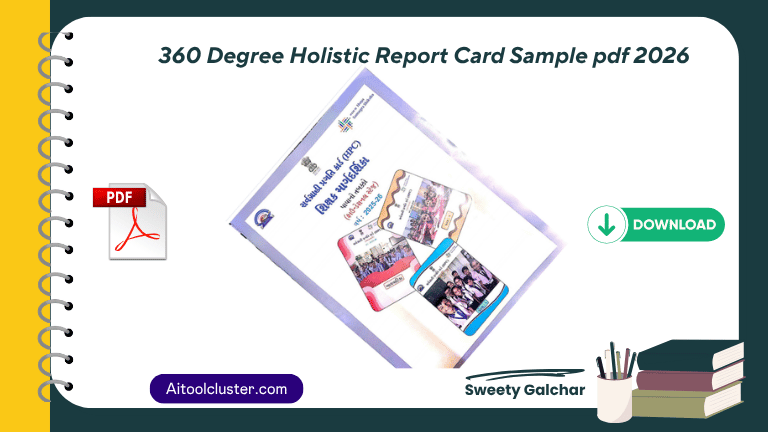
This new assessment system replaces the previous D1, D2, D3, and D4 forms.
Holistic Progress Card, HPC Assessment System, BalVatika Evaluation System, NEP 2020 Assessment, Primary School Evaluation India, Foundational Stage Assessment, Class 1 Assessment System, Class 2 Evaluation Method, Early Childhood Education India, Student Progress Report New System, School Assessment Reform India, Competency Based Assessment, CBSE Holistic Progress Card, Foundational Literacy and Numeracy, FLN Assessment India, New Education Policy Evaluation, Child Development Assessment, BalVatika Learning System, Primary Education Reform India, Student Report Card New Format
360 Degree Holistic Report Card Sample pdf 2026
- Holistic Development: Focuses on the overall growth of the child rather than just academic marks.
- Student-Centric: Designed to put the learner at the heart of the educational process.
- Competency-Based: Evaluates the specific skills and learning outcomes achieved by the student.
- Continuous Assessment: A regular and ongoing evaluation of the student’s progress.
Action Required for Schools:
All schools are hereby informed that for Balvatika and Standards 1-2, only the HPC is to be maintained. There is no longer a requirement to prepare separate result sheets or the old D-series forms.
To ensure there is no confusion regarding this transition, please watch the short video clip provided by Shri Hareshbhai Chaudhary Sir, which explains the process in detail.
ધોરણ 1-2 માં અત્યાર સુધી D1,D2,D3,Ane D4 પત્રકો બનાવતા હતા એના બદલે હવે બાલવાટિકા અને ધોરણ 1-2 બધા માટે HPC જ છે જેથી અલગથી પરિણામ પત્રક બનાવવાના નથી જે તમામ શાળાઓને જાણ કરશો. અને નીચે હરેશભાઇ ચૌધરી સાહેબ દ્વારા આપવામાં આવેલ short clip અવશ્ય સાંભળશો જેથી કોઈ પ્રશ્ન ઉપસ્થિત ના થાય
Holistic Progress Card (HPC): The New Era of Assessment for Balvatika and Std 1-2 (NEP 2020)
The traditional marks-based evaluation system in India is undergoing a massive transformation. Following the guidelines of NCERT, CBSE, and the Ministry of Education, the old D1, D2, D3, and D4 forms are being replaced by the Holistic Progress Card (HPC) for Balvatika (BV) and Standards 1-2.
This shift aligns with the National Education Policy (NEP) 2020, focusing on a 360-degree, competency-based assessment rather than just rote learning.
1. Continuous Formative Assessment
- Oral Assessment: Evaluating verbal communication and expression.
- Written Work: Reviewing creative and structured writing tasks.
- Activity-Based Evaluation: Testing through practical tasks and games.
- Daily Observation Method: Tracking behavior, social interaction, and curiosity in real-time.
2. 360-Degree Involvement: Student, Peer & Parents
- Self-Assessment: Students reflect on their own strengths.
- Peer Feedback: Classmates provide positive reinforcement.
- Parent Participation: Parents share insights about the child’s learning at home. This makes the student feel a sense of ownership over their “Progress Card.”
3. SCF-FS Based Development Domains
- Developmental Domains: Physical, Socio-Emotional, and Cognitive.
- Learning Outcomes: What the child should know by the end of the stage.
- Competencies & Curricular Goals: Moving away from memorization to skill mastery.
HPC and NEP 2020: Focus on FLN
Under the National Education Policy 2020, the Foundational Stage (Balvatika to Grade 2) emphasizes play-based and activity-based learning. The HPC acts as a tool to measure:
- Foundational Literacy & Numeracy (FLN)
- Social & Emotional Development
- Cognitive Skills & Creativity
Implementation Guide for Primary School Teachers
- Maintain a Daily Observation Register: Document small wins and behavioral changes daily.
- Adopt Activity-Based Teaching: Shift from textbooks to hands-on experiences.
- Create Child Portfolios: Keep samples of drawings, worksheets, and projects.
- Discuss HPC in Parent Meetings: Educate parents on how to read the holistic report.
- Stop Traditional Grading: Remember, there is no marks-based system for BV & Std 1-2.
Digital Assessment Reform in India
With the rise of Competency-Based Evaluation and Holistic Education Models, the HPC is a milestone for Gujarat Government Primary Schools and schools across India. This Assessment System Transformation ensures that no child is left behind.
Watch Detailed Video Guide
To understand the technical aspects of the new evaluation method, watch this comprehensive live session:
The Holistic Progress Card (HPC) is more than just a report; it is a movement towards a child-centric future. By moving away from “Marks” and focusing on “Mastery,” we are preparing our children for the challenges of the 21st century as envisioned in NEP 2020.
